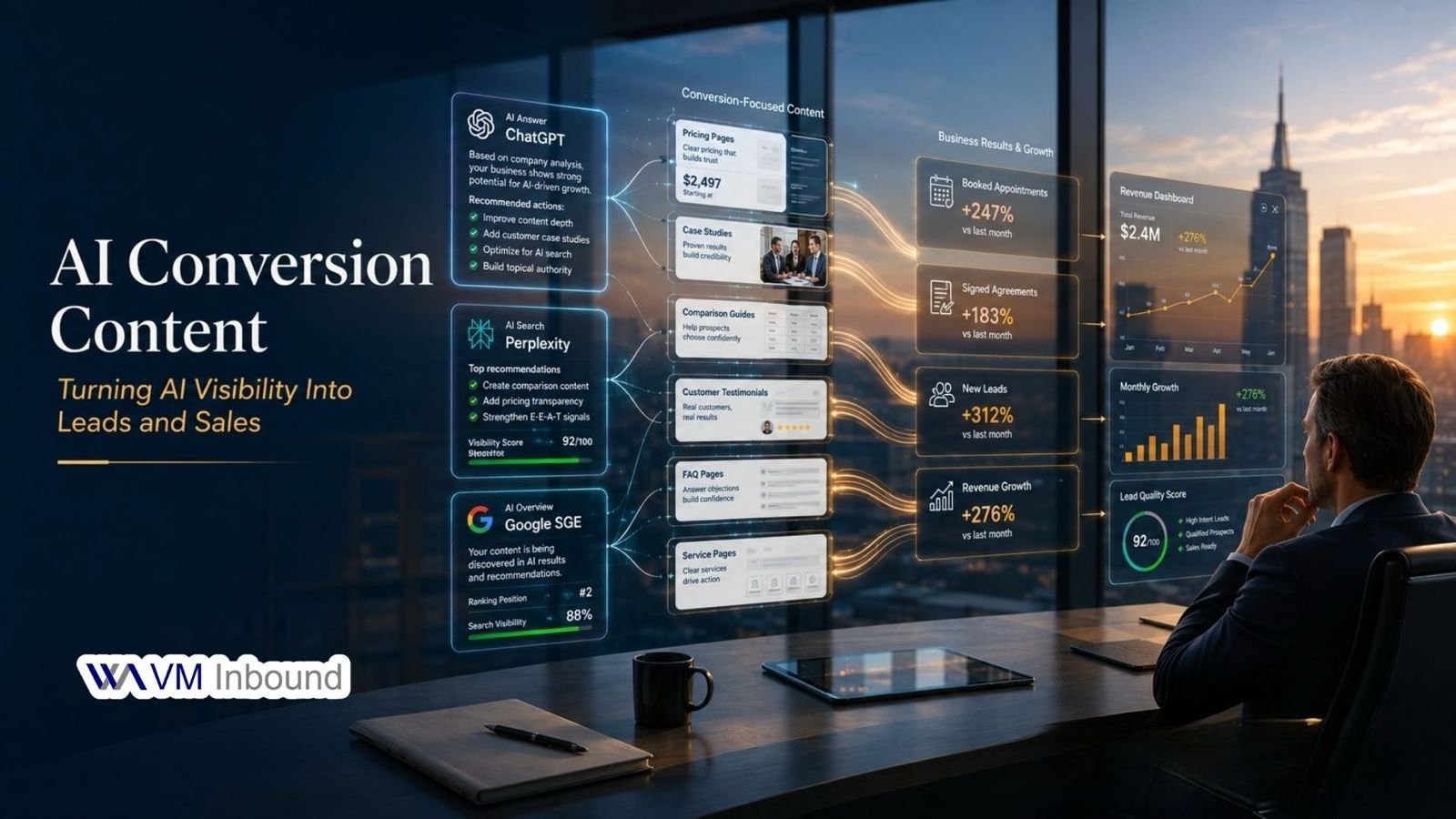
Showing up in AI answers is great, but it does not automatically create revenue. You only get paid when that visibility turns into leads, sales calls, and signed agreements. AI conversion content is what bridges that gap. It is the content that meets people after they discover you through AI and guides them toward becoming a customer.
Instead of stopping at “we appeared in an AI answer,” you want to ask, “How many of those people took the next step?” AI conversion content is built to answer that question. It turns attention into action by removing doubts, clearly explaining your offers, and guiding visitors to a specific next step.
Not getting found like you used to?
See how local customers find you in Google, Maps, and AI tools, and get a simple plan to start winning those calls again.
Why impressions and AI citations are only half the story
Impressions and AI citations can feel exciting. You see your business name inside ChatGPT, Gemini, Perplexity, or AI Overviews, and it looks like you are winning. But these numbers only tell you that people saw your brand, not that they understood it or decided to contact you.
Often, AI will mention you in one short sentence. That sentence might say what you do and where you are, but it cannot show your process, your pricing, or your proof. If someone clicks through to your site and finds generic, unclear content, they will leave quickly. To make AI visibility worth it, you need content that takes over once the AI answer ends.
The Conversion Core: belief-shifting content that sells for you
Think of your content in two buckets. One bucket helps you become visible in AI. The other bucket helps you convert that visibility into a pipeline. The second bucket is your Conversion Core.
Your Conversion Core is a small set of high-impact pages and posts that:
- Change how buyers think about their problem and your solution.
- Answer the real questions that decide whether they take action.
- Make it easy to see what working with you looks like.
Typical Conversion Core pieces include:
- A clear pricing or “how our pricing works” page.
- Comparison content that explains how you are different from other options.
- Case studies that show real results.
- A “who we are a fit for and not for” page or section.
When someone arrives from an AI answer or a brand search, these assets help them move from “I am curious” to “I want to talk to this team.”
Examples of AI conversion content
Here are concrete types of content you can create to turn AI visibility into leads and sales.
Pricing explainers
Money questions stop many buyers from taking the next step. A pricing explainer makes things feel safe and clear. It does not need to list every possible fee. It should:
- Describe your main packages or engagement models.
- Give price ranges or “starting at” points.
- Explain what affects pricing, like scope or complexity.
- Help buyers see which option is likely right for them.
This type of page turns “I am afraid this will be too expensive” into “I know roughly what to expect, and I am ready to talk.”
Comparison and “best for” posts
People ask AI questions like “best X for Y in Z” or “is X better than Y for my situation.” When AI names you, visitors still need to compare options. A good comparison or “best for” post:
- Explains how your approach is different from common alternatives.
- Shows when your service is the better choice and when another path might be smarter.
- Uses real examples and plain language, not just marketing buzzwords.
This content helps buyers feel confident that they are choosing based on facts, not guesswork.
Case studies and success stories
Case studies show that your promises actually work. They are especially powerful for visitors who already understand the basics and just need proof. Effective case studies:
- Identify the client type and situation.
- Describe the starting problem.
- Explain what you did.
- Share the outcome in simple terms.
You can also create short success stories to include on your service pages. These give a quick “this worked for someone like you” signal that builds trust.
“Who we are a fit for and not for” content
One of the best ways to build trust is to say clearly who you serve and who you do not. A “fit” section or page can:
- List the types of businesses or people you help most.
- Mention typical budget ranges or stages where you add the most value.
- Describe traits of good clients, like being open to collaboration.
- Gently explain situations where you are probably not a match.
This honesty makes good-fit prospects feel more comfortable reaching out and saves you time with poor fits.
Internal linking from AI-friendly content to the bottom of the funnel offers
Once you have both visibility content and Conversion Core content, you need to connect them inside your site. Internal links are what guide visitors from high-level information to real offers.
Simple rules that work well:
- Every educational or high-level post should link to at least one core service or offer page.
- Comparison content should link to your pricing explainer and your main call to action.
- Case studies should link back to the service they showcase.
- Your “fit” content should link to a simple next step, such as “Book a 20-minute AI Visibility Planning Call” or “Get an AI Conversion Content Map.”
Use link text that clearly describes what someone gets if they click, not generic phrases like “learn more.” This makes it easy for visitors to follow the path from first impression to contact.
Aligning offers, content, and AI search intent
Many AI questions follow a pattern such as “best X for Y in Z.” To convert those searches, your offers and content should use the same pattern in human language.
You can ask yourself:
- X: Are we describing what we do in the same way buyers search for it?
- Y: Are we clear about who we serve, not just “everyone”?
- Z: Are we clear about our main locations or markets, if we have them?
Your service pages, pricing pages, comparison posts, and case studies should all make these three points obvious. When what you offer lines up with how people ask AI for help, you are much more likely to turn visibility into real conversations and sales.
Get a custom AI Conversion Content Map for your business
If you are working on AI visibility, the next step is to make sure that visibility turns into revenue. You do not need hundreds of pages. You need the right handful of pieces, in the right places, connected by clear paths.
VM Business Solutions can create a custom AI Conversion Content Map for your business. You will see:
- Which Conversion Core assets are you missing?
- Which pricing, comparison, and proof pieces will make the biggest difference?
- How to connect everything so AI-driven visitors move smoothly from first touch to booked call.
If you want a clear, simple plan to turn AI visibility into leads and sales, request your AI Conversion Content Map, and we will outline it for you.