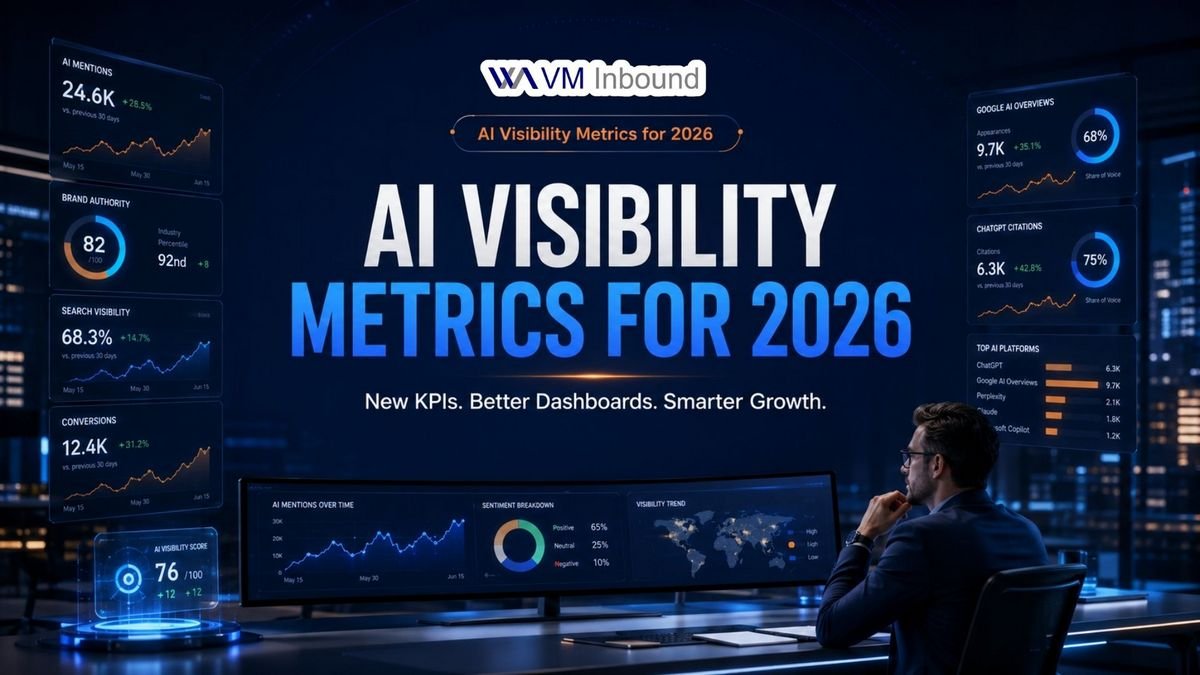
Most businesses still track SEO success using the same two numbers they have watched for years: rankings and clicks. In a search world that increasingly runs on AI answers, those numbers no longer tell the full story. You can show up in AI Overviews, ChatGPT, Gemini, or Perplexity, influence a buying decision, and never see a single click or classic “organic session” in your analytics.
If you want to take AI visibility seriously in 2026, you need a new measurement model. That model still includes traffic and conversions, but it also adds visibility inside AI tools, signals that support your authority, and a clear link between search activity and revenue. This blog will walk you through those pieces and show you how to build a simple, useful AI visibility dashboard.
See how your local business really shows up in Google, Maps, and AI tools
and get a simple action plan to start winning nearby calls and leads again.
Why clicks and rankings are not enough in an AI-first search world
Rankings and clicks are still important, but they leave big blind spots. AI systems often answer questions directly inside the interface. Users may never see a traditional results page and may never click to your site, even if your brand influenced their decision.
A few examples:
- Someone asks an AI for “best small business accountant in my city.” The AI names your firm, explains why you are a good fit, and the user searches your brand name directly later.
- An AI Overview in Google summarizes your guide, uses your insights in its answer, and the user calls you from a local listing instead of visiting your site.
- A buyer compares options inside an AI chat, learns that you specialize in their type of business, and then visits your site from a branded search.
In all these cases, the old metrics undercount your impact. They miss the fact that AI helped put you into the consideration set. If you only look at rankings and clicks, you undervalue AI visibility and struggle to justify ongoing optimization work.
New visibility metrics for AI search
To measure AI visibility properly, you need to track how often you appear where buyers are now doing their research. The data will never be perfect, but even rough signals are better than flying blind. Here are four categories to focus on.
1. Impressions in AI Overviews and similar surfaces
Start by monitoring:
- How often do your pages appear in AI Overviews and similar search features?
- Which queries trigger these appearances?
- Which types of pages tend to show up most often?
Over time, you can see whether your entity signals, structured data, and topical depth are helping you surface in more AI-driven search experiences.
2. Citations and mentions in AI answers
Next, pay attention to how often AI tools name or cite your brand. You can do this manually regularly by asking questions such as:
- “Who are the best providers of [your service] in [your city or niche]?”
- “Which companies specialize in [your niche] for [your audience]?”
Track:
- Whether your brand appears at all.
- How are you described?
- Which competitors are named alongside you?
This gives you a working picture of your standing inside AI-generated recommendations.
3. Placements and brand mentions across AI tools
AI search is not one platform. Buyers use many tools, often in combination. Make a short list of tools that matter most to your audience, for example:
- Google AI Overviews
- ChatGPT
- Gemini
- Perplexity
Regularly check how often you appear across these tools and for what types of queries. Even simple tracking in a spreadsheet can reveal patterns and gaps.
4. Branded search and discovery trends
Finally, watch for changes in:
- Branded search volume over time.
- The ratio of branded to non-branded organic traffic.
- Direct traffic that matches your target regions and industries.
When AI visibility improves, more people often look you up by name or visit you directly. This is not perfect proof, but it is a useful supporting signal.
Signals that matter: authority, topical depth, structured data, reviews, engagement
AI tools rely on more than just a single web page. They look at the overall strength and clarity of your presence. For measurement and optimization, pay attention to four key signal groups.
Authority
Authority signals include:
- Quality and relevance of sites that link to you.
- Mentions of your brand on trusted platforms.
- Thought leadership and contributions that make you look like an expert.
You do not need hundreds of links. You need a steady, credible pattern that shows you are trusted in your space.
Topical depth
AI prefers to recommend entities that demonstrate real expertise around a topic. Track:
- Number of in-depth pieces around your core services and audience.
- Coverage of buyer questions along the full journey, from basics to detailed comparisons.
- Freshness of your content in key topic clusters.
If you have only shallow content around a generous offer, that is a clear priority for improvement.
Structured data and technical clarity
Structured data helps AI understand what each page is about and how it fits into your business. Monitor:
- Where you have LocalBusiness, Service, FAQ, and related schema in place.
- Whether your schema is valid and up to date.
- How consistently does your data reflect your current offers and locations?
This is a small investment that can make a large difference in how machines interpret your site.
Reviews and engagement
Reviews and engagement show that you are active and trusted today, not just in the past. Track:
- Total and recent review counts on key platforms.
- Average rating and trend over time.
- Detail and specificity of reviews, not just star scores.
- Engagement signals on your site, such as time on key pages and conversion rates.
These metrics help you see whether your authority and trust signals are moving in the right direction as you work on AI visibility.
How to build a simple AI visibility dashboard
You do not need a perfect data stack to start measuring AI visibility. A simple dashboard in a spreadsheet or lightweight reporting tool is enough, as long as it is consistent. Think in terms of four sections.
1. Presence in AI answers and Overviews
Create a table with rows for your main service and location combinations. Columns can include:
- Appears in AI Overview (yes or no, plus example query).
- Appears in named AI tool answers for key prompts (yes or no).
- Description used by the AI when it mentions you.
Update this monthly or quarterly so you can spot changes.
2. Entity and signal health
List key elements and track a simple status:
- NAP consistency across your site and major listings.
- Google Business Profile completeness and activity.
- Presence of schema on key pages.
- Review volume and average rating across main platforms.
Use a simple green, yellow, red system or scores to highlight where work is needed.
3. Traffic and brand awareness indicators
Pull basic data from your analytics tools:
- Branded vs non branded organic sessions.
- Direct traffic trends.
- Top landing pages from organic and where they sit in your funnel.
Note major changes that coincide with AI visibility work, such as a rise in branded searches after you start showing up more in AI answers.
4. Conversion and sales outcomes
Finally, connect all of this back to real business results. Track:
- Organic and direct leads per month.
- Booked consultations that originate from search and AI-related channels.
- Closed revenue from those leads.
Even if attribution is not perfect, you will start to see whether improvements in AI visibility are lining up with better lead and revenue numbers.
Aligning AI visibility KPIs with sales KPIs
AI visibility should never be a vanity project. The point is to drive qualified leads, stronger deal flow, and better revenue. To keep everything aligned, pair your AI visibility metrics with clear sales metrics.
For example:
- AI visibility target
Increase the number of service and location combinations where you are named in AI answers.
Sales target
Increase qualified inbound leads from your target regions by a specific percentage. - AI visibility target
Improve topical depth around a high-value service with a set number of new guides and case studies.
Sales target
Increase discovery calls or strategy sessions booked for that service. - AI visibility target
Grow reviews and authority signals in your niche.
Sales target
Improve close rates on leads that found you through search and AI-influenced channels.
Review these pairs regularly with your team. When you adjust your content or technical setup, watch how that impacts both AI visibility and sales outcomes. Over time, this makes it much easier to justify ongoing investment and retainer-style work because you can point to a clear link between AI work and revenue.
Apply for our AI Visibility and Conversion Program
Knowing what to measure is only part of the challenge. The real work is using those insights to improve visibility, leads, and sales month after month. Many businesses have pieces of this in place, but lack a simple, repeatable system.
Our AI Visibility and Conversion Program is built for that. In this program, we:
- Track your AI visibility across key tools and search experiences.
- Strengthen your authority, content depth, structured data, and review signals.
- Build and refine the conversion paths that turn AI-driven attention into booked consultations and revenue.
If you want a measurement routine that supports real growth, not just pretty dashboards, apply for our AI Visibility and Conversion Program, and we will show you what this could look like for your business.
Get a free local business AI audit plus a clear checklist of fixes
so more people who find you in Google, Maps, and AI chats turn into real inquiries and bookings.