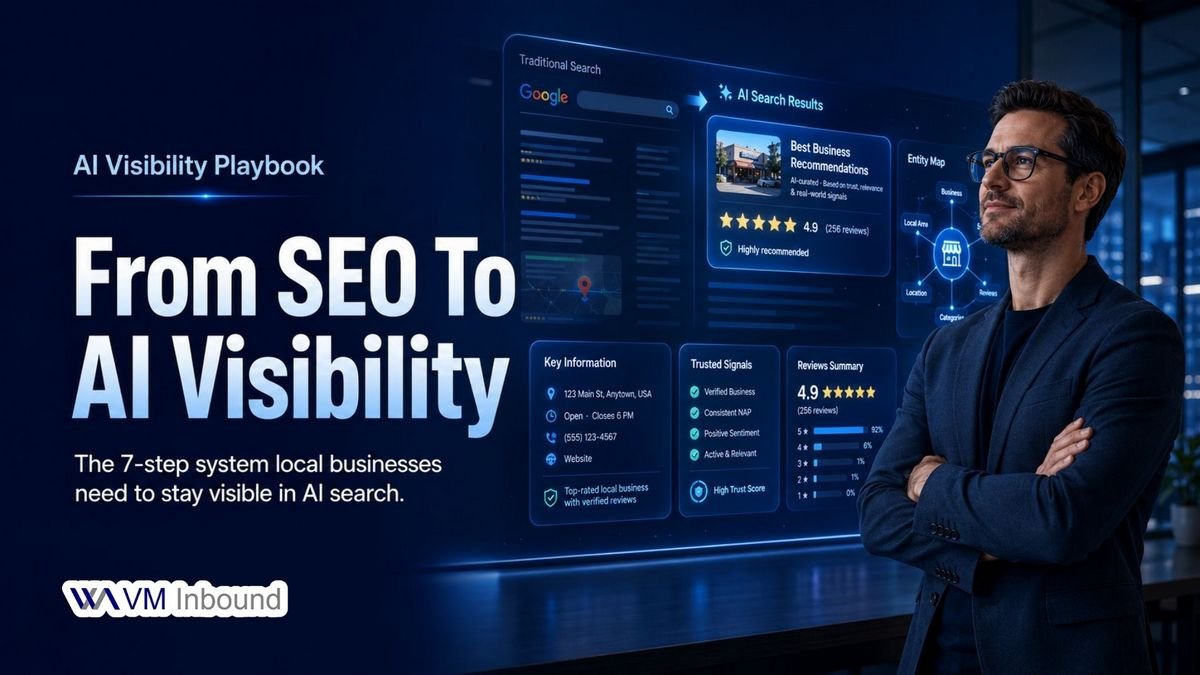
Traditional SEO helped you rank in Google search results. AI visibility decides whether you get mentioned at all when someone asks ChatGPT, Gemini, Perplexity, or Google’s AI Overviews for recommendations. In a world where buyers increasingly ask AI for “the best [service] near me,” it is not enough to sit on page one of Google and hope for clicks.
AI tools try to answer questions directly and then name a few trusted businesses. If your brand is not clearly understood, easy to explain, and supported by real proof, the AI will recommend your competitors instead. This playbook shows how to move from old-school SEO tactics to a structured AI visibility strategy that fits local and service businesses.
Why AI visibility matters now
For years, the goal of SEO was simple: get your pages to rank higher than your competitors. Buyers would type a query, scan a list of links, and click through to a few websites before deciding who to contact. You could still win attention even if your message was not perfect, because people were forced to shop around.
Today, buyers increasingly ask AI tools to do the research for them. Instead of typing “best HVAC companies in Philadelphia” into Google, they ask an AI assistant for a recommendation. The assistant returns a short list of names and often explains why those companies are a good fit. If you are not on that short list, you do not even get a chance.
AI visibility is about making sure your business is easy for these systems to understand, trust, and include in their answers. The good news is that many of the skills you learned in SEO still matter. You just need a new order of operations and a more structured way of showing who you are, who you serve, and why you are the safe choice.
Step 1: Clarify offers and ideal buyer questions
Most SEO starts with keywords. AI visibility starts with offers and questions. Before you think about search phrases, you should define exactly what you sell and who you sell it to.
Ask yourself:
- What are our core offers, in plain language?
- Who are our best-fit buyers?
- What problems are they trying to solve when they look for us?
- What questions do they ask before they feel confident to book a call?
Make a simple list of 3 to 5 main offers, such as “residential roof replacement,” “small business tax preparation,” or “AI search optimization for local service businesses.” Under each offer, write down the top questions buyers ask in sales calls, emails, or DMs. For example:
- How much does it cost?
- How long does it take?
- What is included?
- Do you serve my neighborhood or industry?
- What makes you different from others?
These questions become the foundation for your content and page structure later. Instead of chasing hundreds of keyword variations, you design your website around the real decisions your best buyers need to make.
Step 2: Fix core data and local signals
Next, you need to make your basic business data boringly consistent. AI tools cross-check information across your website, Google Business Profile, review sites, and directories. If they find conflicting details, you look risky and vague.
Focus on three things first:
- NAP consistency
Your name, address, and phone number must match across:- Your website
- Google Business Profile (GBP or GMB)
- Yelp, Facebook, Apple Maps, and major directories
- Any industry-specific platforms you use
- Use the same spelling, abbreviations, and formatting everywhere.
- Google Business Profile
Treat your GBP as a primary asset, not an afterthought.- Choose the most accurate primary category and a few relevant secondary categories.
- Fill out your description with the same positioning you defined in step 1.
- Add services and products where appropriate, with short descriptions.
- Upload recent photos that show your work, your team, or your location.
- Basic schema on your site
Implement LocalBusiness or the correct subtype on your homepage and contact page. Include:- Business name, address, phone, website URL
- Opening hours
- Same categories and service descriptions you use in GBP
This step might not feel glamorous, but it tells AI systems that you are a real, consistent entity. Without this, later efforts are much less effective.
Step 3: Build Conversion Core pages
Your Conversion Core is a small set of high-intent pages that answer the most important questions buyers have before they contact you. Instead of spreading your message across dozens of weak pages, you build a few strong ones that do the heavy lifting.
At a minimum, you want:
- A focused homepage that explains exactly who you are, what you do, who you help, and where you operate.
- One strong page for each core offer you defined in step 1.
- A contact or “Book a Call” page that is simple and clear.
Each Conversion Core page should:
- Start with a direct statement of what the page is about.
- Include a section “Who this is for” that describes your ideal buyer.
- Explain your process in simple steps so buyers and AI can follow it.
- Answer common objections and questions in a mini FAQ section.
- Include a clear call to action, such as “Request a quote” or “Book a 20-minute AI Visibility Planning Call.”
When you design pages this way, you make it easy for AI to pull accurate, self-contained answers for many different queries.
Step 4: Add structured data and entity linking
Once your core pages and data are in good shape, you can help AI connect the dots with structured data and smart linking.
- Schema for pages and FAQs
- Use the LocalBusiness schema on your homepage and contact page.
- Use the Service schema on major service pages, describing each offer with name, description, and area served.
- Use the FAQ schema on sections where you answer specific questions.
- This gives machines a clear, machine-readable summary of what each page covers.
- Internal linking based on entities
Link between pages in a way that mirrors how humans talk about your services. For example:- On your homepage, link to “AI Search Optimization for Local Businesses” using that phrase.
- On your AI optimization page, link back to your “About” or “Why Work With Us” page where you highlight your experience.
- From blog posts, link clearly to the relevant service page as the next step.
- External entity signals
Where relevant, connect your brand to other entities:- Mention cities, neighborhoods, and industries you serve naturally.
- Embed map snippets or use address details that match your GBP.
- Link out to professional associations, tools, or platforms that your audience recognizes.
Together, structured data and entity linking tell AI not only what each page says, but how everything relates inside a larger story of who you are.
Step 5: Generate topical depth with supporting posts
After your Conversion Core is live, you can expand around your offers with what you might call conversion clusters. These are sets of supporting posts and resources that surround a service page and answer more specific, long-tail questions.
For example, if your core offer page is “AI Search Optimization for Local Businesses,” supporting posts might include:
- “How AI answers are changing local search for home service companies.”
- “Checklist to prepare your website for AI-generated search results.”
- “Common AI visibility mistakes local businesses make and how to fix them.”
- “How to ask AI tools for recommendations and test your own visibility.”
Each supporting post should:
- Target a specific buyer question, concern, or scenario.
- Link clearly to the main service page as “what to do next.”
- Use the same language and positioning you use in your Conversion Core.
This topical depth helps AI see you as a specialist rather than a generalist. It also creates more opportunities for AI answers to quote or reference your content.
Step 6: Turn reviews and case studies into AI-friendly proof
AI tools care not only about what you say, but also about what others say about you. Reviews and case studies are powerful signals, especially for local and service businesses.
Here is how to make them AI-friendly.
- Improve the volume and freshness of reviews
- Ask recent happy clients to review you on Google and one or two other key platforms.
- Encourage them to mention the service they received, their location, and the result.
- Aim for a steady flow of new reviews rather than a one-time spike.
- Use reviews on your site in a structured way
- Add star ratings and short testimonials to relevant service pages.
- Group reviews by service or location when possible.
- Make sure the text is real, specific, and not filled with generic praise.
- Publish simple, focused case studies
You do not need long stories. A strong case study can be:- Client type and location
- The problem they had
- The service you provided
- Outcome in clear terms
- Place these on your service pages and link them from relevant supporting posts.
When AI sees consistent reviews, ratings, and outcomes lined up with your offers and locations, it becomes much easier to justify recommending you.
Step 7: Measure success differently in the AI era
Traditional SEO often focused on rankings and clicks. AI visibility requires a broader view of success. Many buyers will get what they need from an AI answer and then search for your brand name or contact you through other paths. You want to measure signals that reflect your growing presence inside AI, not only traffic.
Consider tracking:
- Brand searches over time
If more people search your name plus a service, it suggests that other channels, including AI answers, are driving awareness. - Mentions and placements in AI tools
Regularly ask AI assistants for recommendations in your niche and region. Track when your business starts to appear in these answers and how it is described. - Impressions and views in GBP and key directories
These often rise as your entity signals and reviews improve, even before website traffic catches up. - Conversions from organic and direct traffic
Form fills, calls, booked consultations, and other clear actions matter more than raw session counts.
In the AI era, the goal is not just to win a blue link position. The real goal is to become the obvious, low-risk recommendation whenever someone asks for help that matches your offers.
Book a 20-minute AI Visibility Planning Call
You do not have to rebuild your entire marketing system to start winning in AI search. You do need a clear, realistic plan that fits your offers, your market, and your current assets.
If you want help mapping this 7-step playbook to your business, book a 20-minute AI Visibility Planning Call. On this brief call, you will:
- Get a quick read on how visible your business is right now in AI-driven searches.
- Identify the biggest gaps in your data, content, and proof that are holding you back.
- Walk away with a simple, prioritized action list for the next 30 to 60 days.
Use the call to decide whether AI search optimization should be a core focus for your growth this year, and how to tackle it without guesswork or wasted effort.