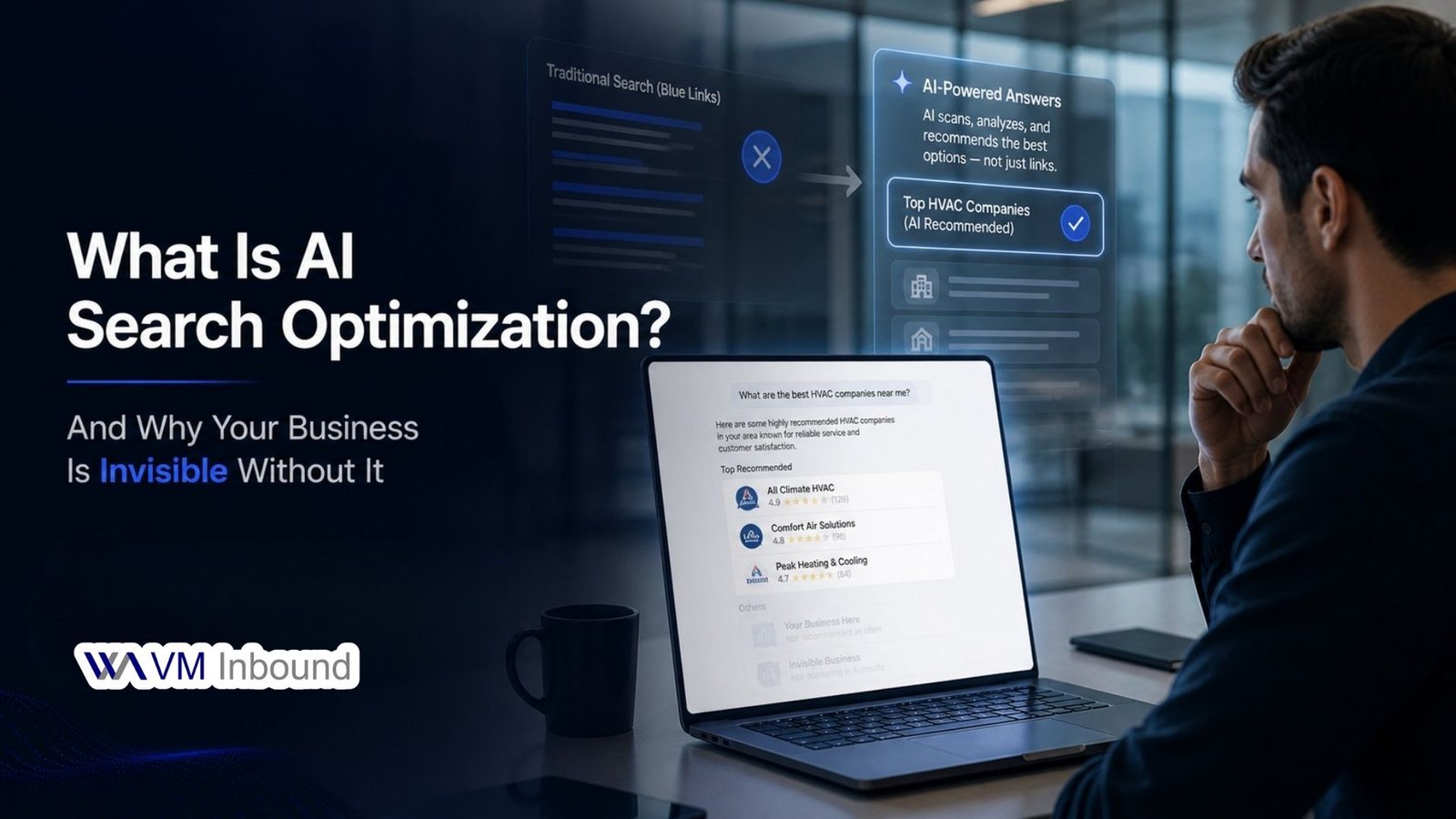
You already know you need SEO. But there’s a new layer sitting above Google’s blue links: AI answers. If you aren’t intentionally optimizing for those AI answers, your business is quietly becoming invisible, even if you still “rank” in search.
This post will walk you through what AI search optimization is, why traditional SEO is no longer enough, how AI actually chooses who to recommend, five signs you’re invisible, and a 30‑day checklist to fix it. At the end, you’ll see how an AI Visibility Audit can give you a clear, prioritized path forward.
The shift from Google blue links to AI answers
For two decades, search meant: type a query into Google, scan a page of blue links, click a few, and try to piece together your own answer. Today, more and more of that research is happening inside AI tools like ChatGPT, Gemini, Perplexity, and Google’s AI Overviews.
Instead of returning 10 blue links, these tools generate an answer and then cite only a small handful of sources (if any at all). For queries like:
- “Best IT support companies for small businesses in Philadelphia”
- “Who are the top bookkeeping services for solopreneurs?”
- “Which marketing agency specializes in local lead generation?”
AI models will often respond with a paragraph of advice and then name one to five specific businesses they “recommend.” There is no page two. You’re either:
- In the answer (named and linked), or
- Invisible.
This is the biggest visibility shift in search since Google itself. Businesses that adapt early will benefit from disproportionate exposure. Businesses that stay focused only on traditional SEO will see their organic traffic decline as more users get everything they need from an AI answer, without ever visiting a search results page.
Why traditional SEO is no longer enough
Traditional SEO is still necessary. You still want healthy technical SEO, on‑page optimization, backlinks, and local SEO. But it’s no longer sufficient, because it was built for ranking pages, not for being selected as the recommended entity inside an AI answer.
The key shift: AI cares less about keywords and much more about entities, context, and “identity authority.”
Think of it this way:
- Keywords describe what people type.
- Entities describe what actually exists in the real world: your business, your services, your team, your city.
AI tools are designed to understand and connect entities: “VM Business Solutions,” “small business marketing,” “Philadelphia,” “AI search optimization,” and so on. Their goal is to answer a user’s question with the most trustworthy, clearly defined entities they can find.
Here’s how the mindset changes:
- Old SEO question: “How do we rank this page for ‘Philadelphia SEO agency’?”
- AI search question: “How do we make sure AI clearly understands that we are the specialized, trustworthy SEO & AI optimization partner for small businesses in Philadelphia, and feels confident enough to recommend us by name?”
AI doesn’t just scan your site for a keyword match; it asks:
- Who are you, exactly?
- Where are you, exactly?
- What are you known for?
- Are you active and trusted?
- Can I safely recommend you to this user?
If your strategy is still built around stuffing keywords into pages, chasing backlinks, and writing generic blog posts, you might maintain some rankings, but you’ll struggle to be selected inside AI answers where real buying decisions get made.
How AI decides who to recommend
AI models don’t use a simple “top 10 links” ranking system. They search across the web and their internal knowledge to identify entities that best fit the user’s intent. Then they choose a few that are clear, safe, and easy to explain.
Here are the main ingredients they look at.
1. Knowledge graphs and entity clarity
AI systems rely on knowledge graphs, massive maps of entities and their relationships. These connect:
- Businesses (your brand)
- Categories (e.g., “accounting firm,” “roofing contractor,” “SEO agency”)
- Locations (e.g., “Philadelphia,” “South Philly,” “Fishtown”)
- Services and specialties (e.g., “AI search optimization,” “e‑commerce bookkeeping”)
If your business isn’t clearly represented in that graph, through your website, local listings, and mentions across the web, AI has nothing solid to latch onto. You’re effectively a ghost.
Strong entity clarity looks like:
- Your exact business name is consistently used everywhere.
- Clean, matching address and phone across your site and directories.
- Clear service descriptions and niches that tie you to specific problems and audiences.
2. Structured data and AI‑friendly formatting
AI is powerful, but it still prefers a clean structure over chaos. It loves:
- Schema markup (LocalBusiness, Service, FAQ, Product).
- Clear headings that mirror real questions customers ask.
- Short, direct answers can be safely quoted.
When your pages are organized like this:
- H1: “AI Search Optimization for Small Businesses in Philadelphia”
- H2: “Who We Help”
- H2: “How AI Search Optimization Works”
- H2: “Pricing and Packages”
- FAQ section with concise Q&A
…it becomes very easy for AI to extract a sentence or two that precisely describes who you are and what you do. If instead your pages are messy, vague, or design‑heavy with little actual text, AI has to guess, and it often chooses not to.
3. Reviews and external trust signals
AI does not trust your site alone. It cross‑checks:
- Google Business Profile
- Yelp, Facebook, industry directories
- Niche review sites
- Press mentions and local citations
It looks at:
- Volume of reviews
- Average rating
- Recency and “velocity” (how often new reviews come in)
- Specificity (reviews that name services, outcomes, and locations)
A business with 120 reviews in the last 18 months, averaging 4.8 stars, is much easier to recommend than one with 7 reviews from 2019, even if the older business has a nicer website.
4. Topical depth and specialization
AI needs brands it can rely on for many related questions, not just one. That means:
- Multiple high‑quality articles, guides, and FAQs around your core services.
- Content that covers common objections, comparisons, and “how to choose” angles.
- Case studies or examples that show real‑world application.
If you’re a “General Digital Marketing Agency” with a single vague services page, you’ll be outranked (in AI) by a “Local SEO and AI Search Optimization Partner for Home Service Businesses” with 15 pieces of content targeting that niche’s real problems.
5. Consistency across the web
AI models see the web as a single, giant dataset. When they notice:
- Identical NAP (name, address, phone) everywhere
- Consistent service descriptions
- Similar messaging across your website, profiles, and content
…they treat your identity as solid. When they spot conflicting names, addresses, categories, or brand positioning, your “trust score” drops. Consistency isn’t just a local SEO best practice anymore; it’s a core requirement for AI visibility.
5 signs your business is invisible in AI search
You don’t need advanced tools to get an initial sense of your AI visibility. You can spot red flags just by how your business appears (or doesn’t appear) when you use AI tools yourself.
Here are five big warning signs.
1. You rank in Google, but AI never names you
Try this: in ChatGPT, Gemini, Perplexity, and Google’s AI Overviews, ask things like:
- “Best [your service] providers in [your city]”
- “Who are reputable [your niche] specialists near [your city]?”
- “Recommend a [your service] company for [your type of client].”
If you consistently see competitors recommended and your brand never appears, that’s a clear sign you’re invisible in AI search, even if you hold solid Google rankings for similar queries.
2. Your homepage doesn’t clearly say what you do and where
If your homepage starts with a vague slogan like:
“We help businesses grow with innovative solutions.”
…AI has to work harder to figure out what you actually are. It needs direct statements like:
- “We are a digital marketing and AI search optimization agency based in Philadelphia, serving small and mid‑size service businesses across the U.S.”
If someone (human or AI) can’t answer “who are they, where are they, what do they do, who do they help?” in 10 seconds, that’s a problem.
3. Your local listings are a mess
Common issues that hurt your AI visibility:
- Different addresses or phone numbers across platforms.
- Old locations still live in directories.
- Missing categories or vague ones like “Consultant.”
- Half‑completed profiles with no description, photos, or services.
These inconsistencies send a simple message: “uncertain entity.” AI doesn’t like uncertainty, so it chooses safer, cleaner options.
4. Your content is thin and generic
If your blog is filled with generic, 600‑word posts that could belong on any competitor’s site, you’re not building topical authority. Ask yourself:
- Do we have in‑depth, practical guides that truly help our ideal clients?
- Do we answer the real questions people ask in sales calls, emails, and DMs?
- Do we have content that compares options, explains trade‑offs, and helps people choose?
If not, AI has little reason to treat you as an expert worth citing or recommending.
5. Your reviews are weak, old, or one‑sided
If your profile looks like:
- 9 Google reviews from 2018–2020
- Nothing on Yelp or industry sites
- No recent reviews at all
…AI will assume you’re either not very active or not a clear leader in your space. At a minimum, you want a steady flow of fresh, detailed reviews across the platforms that matter in your niche.
Simple 30‑day checklist: what to fix first
You don’t need to rebuild everything overnight. The goal in the next 30 days is to send a much stronger, clearer signal about who you are, what you do, and why you’re safe to recommend.
Here’s a practical, focused checklist you can implement quickly.
Week 1: Clarify your identity
- Rewrite the first screen of your homepage.
Make sure it clearly answers: who you are, what you do, who you serve, and where. Example:
“VM Business Solutions is a Philadelphia‑based marketing and AI search optimization partner for small and mid‑size service businesses across the U.S.” - Add a “Who We Help” block.
List 3–5 ideal client types and verticals so AI can connect your brand to those entities. - Make your contact and location details unmissable.
Put your full business name, address (if applicable), phone, and primary service area in the footer and on your Contact and About pages.
Week 2: Clean up your presence across the web
- Audit and fix your major listings.
Review and update:- Google Business Profile
- Yelp
- Facebook Page
- Key industry directories (Clutch, Expertise, niche directories, etc.)
- Ensure consistent name, address, phone, website URL, hours, services, and categories.
- Strengthen your primary profile descriptions.
Write or update descriptions so they match your homepage positioning: same language around services, audience, and location.
Week 3: Make your content AI‑friendly
- Upgrade one core service page.
Choose your highest‑value service, and:- Add clear H2 sections: “Who This Is For,” “What’s Included,” “Our Process,” “Pricing,” “Frequently Asked Questions.”
- Use bullets and short paragraphs so answers are easy to extract.
- Include location context where relevant (“serving clients in Philadelphia and nationwide”).
- Add an FAQ block.
Answer 5–7 real questions prospects ask, in plain language. This makes it far easier for AI to lift accurate snippets. - Publish one flagship guide or checklist.
Example: “AI Search Optimization Checklist for Service Businesses in 2026.” Make it practical, specific, and structured with clear headings.
Week 4: Boost your proof and freshness
- Launch a 2‑week review campaign.
Reach out to recent happy clients and ask for detailed reviews on:- Google (always)
- One additional platform that matters in your niche
- Give them prompts like: “What problem did we solve? What service did we provide? Where are you located?” so the review text reinforces your entity and services.
- Add 2–3 short, specific case snippets.
On your homepage or service page, add mini case studies (even 3–4 sentences each) highlighting client type, location, problem, and result.
By the end of 30 days, you won’t have a perfect AI search presence, but you will look far more like a clearly defined, trustworthy entity that AI tools can understand, quote, and recommend.
Get an AI Visibility Audit (So You’re Not Guessing)
Right now, most businesses have no idea how often they’re appearing inside AI answers, or whether they’re being skipped in favor of competitors. They’re flying blind while search behavior shifts underneath them.
That’s why VM Business Solutions offers an AI Visibility Audit.
Inside this audit, we:
- Test how often your business is named or recommended across major AI tools (ChatGPT, Gemini, Perplexity, and AI Overviews) for the searches that actually matter to you.
- Analyze your website, content, and schema to see how easily AI can understand and reuse your information.
- Review your local and industry profiles for entity clarity, consistency, and trust signals.
- Deliver a prioritized 30‑ to 60‑day game plan to move from “barely mentioned” to “consistently recommended” for your highest‑value searches.
If you want help making sure your business shows up where your customers are really searching now, inside AI answers, request your AI Visibility Audit today, and let’s turn invisible traffic into visible opportunities.