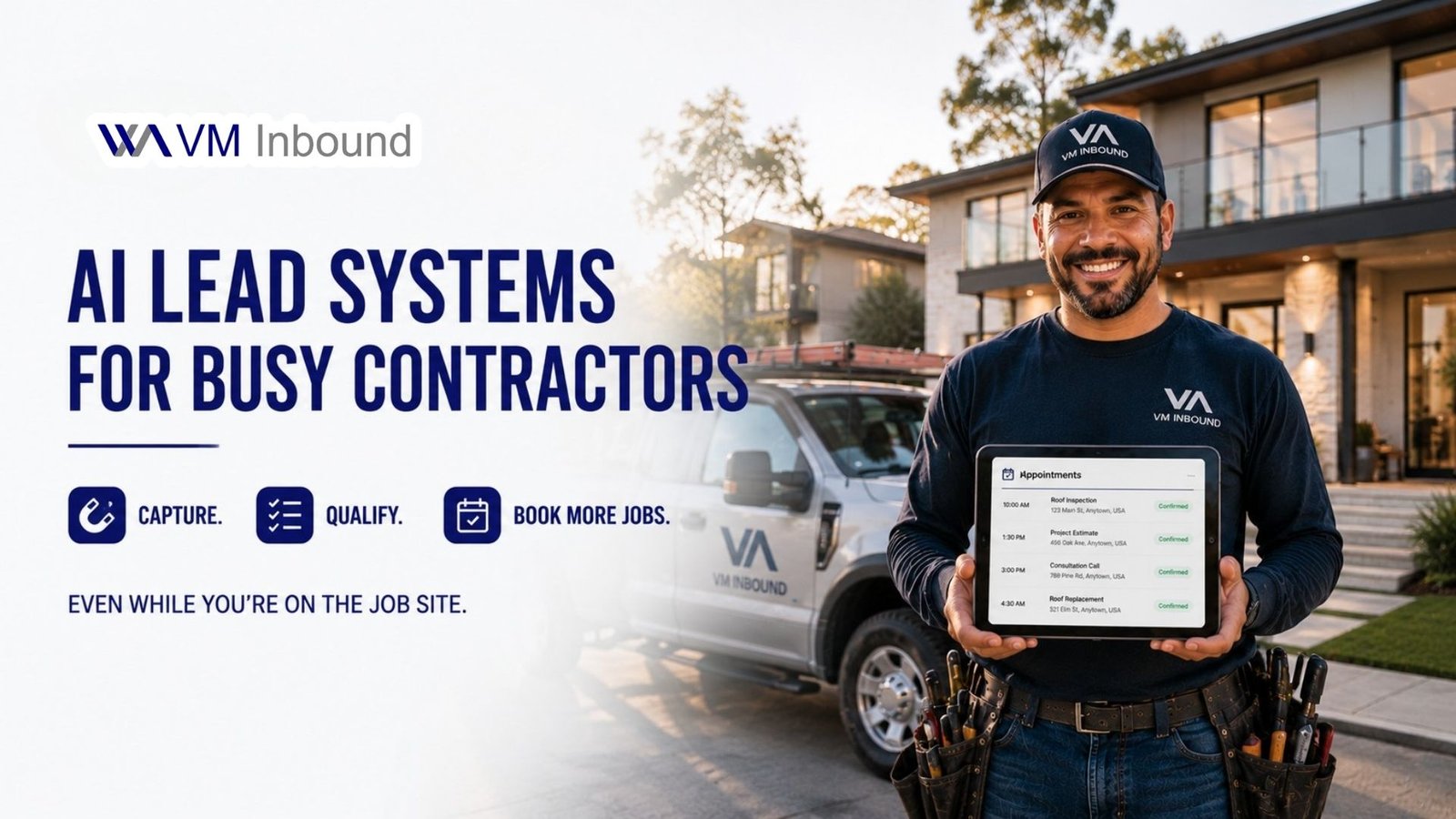
You don’t get paid to sit behind a laptop; you get paid when you’re on the job site. The problem is, leads don’t stop coming in just because you’re pouring concrete, up on a roof, or stuck in traffic. You need an AI lead system that quietly captures, qualifies, and books high-value projects in the background, so your pipeline grows even while you’re out doing the work.
Unlock Your AI Lead System Audit
1. Turn One Landing Page Into Your Always-On Lead Hub
Before you add AI, you need one simple place where every potential client is sent, your “lead hub” landing page.
Make the page specific, not generic
High-converting lead funnels use focused pages, not catch-all homepages. For a contractor or local service business, that might look like:
- Headline: “AI Lead Systems For Busy Contractors”
- Subheadline: “Capture, qualify, and book more jobs, even when you’re on the job site.”
- Short explainer: A 3–4-bullet outline of how your process works.
- Proof: Photos, testimonials, or a mini case study.
- One primary call to action: “Request Your Free AI Lead System Audit.”
Instead of “We do everything for everyone,” you’re inviting a very specific type of client into a very specific system, which is exactly what AI workflows perform best with.
Route all traffic into that hub
To keep your life simple, everything should funnel into that one page:
- Facebook and Instagram ads
- Google Business Profile and online directory links
- QR codes on flyers, site banners, and vehicle decals
- Email signatures and messaging app profiles
When all roads lead to your lead hub, every new prospect enters the same predictable process that AI can handle for you.
2. Let AI Capture, Qualify, And Follow Up While You Work
Once prospects land on your lead hub, AI tools can take over the repetitive “front desk” work you shouldn’t be doing from a ladder.
Put an AI chatbot to work on the page
A good chatbot shouldn’t try to be your closer. Its job is to be a fast, friendly filter:
- Greet visitors and answer common questions (services, areas you cover, basic price ranges).
- Ask a few smart qualifiers: location, project type, budget, ideal start date.
- Send promising leads straight to a booking form or calendar.
Example instructions you could give your bot:
“Ask where the property is located and what kind of project they’re planning.
Ask for their rough budget range and target start date.
If they’re in my service area, have a realistic budget, and want to start in the next 60 days, invite them to book a site visit or strategy call.”
Most modern AI lead-gen platforms and CRMs make this kind of logic easy to set up with visual workflows, no custom code required.
Replace static forms with smart, AI-assisted forms
Old-school “Contact Us” forms put all the work on the prospect and all the follow-up on you. Smart forms do more of the heavy lifting:
- Show different follow-up questions based on earlier answers (e.g., remodeling vs. roofing vs. small repairs).
- Tag and score leads automatically (service type, budget band, timeline) in your CRM.
- Feed those tags into automation so high-score leads get fast, personalized outreach.
For example, someone picks “Home Renovation,” indicates the size of the property, and selects “Within the next 3 months.” The system can instantly label them “High Potential Renovation – Short Timeline” and drop them into a priority follow-up track.
Use AI to run your first week of follow-up
Most leads are lost not because they’re bad, but because nobody follows up consistently. AI solves that by sending timely, relevant messages while you’re on the job:
Build at least these three sequences:
- New inquiry sequence: 3–5 SMS or emails over 5–7 days that thank them, share a quick win (like “5 things that affect your project price”), and push a clear call-to-action such as “Book Your Site Visit.”
- Quote sent sequence: reminders, FAQs, and “next steps” nudges after you send a proposal, helping prospects decide without you rewriting the same email over and over.
- Dormant leads sequence: occasional check-ins and seasonal updates for people who went quiet but might still be interested.
Use AI to draft these messages in your voice, friendly, direct, like you’re talking to a neighbor, then you edit and lock the final versions in. After that, your system sends them automatically, 24/7.
3. Connect Everything To Your Calendar And Keep It Lean
An AI lead system is only useful if it ends at booked conversations you can actually attend.
Sync workflows to a real booking calendar
Connect your chatbot, forms, and follow-up sequences to a proper booking tool that reflects your real-world schedule:
- Working hours: days and times you’re available for calls or site visits
- Buffer times: travel and prep time between appointments
- Capacity: how many meetings per day you can realistically handle
When a lead meets your qualification criteria, your automation sends them a calendar link to choose a slot, no endless back-and-forth messaging. You spend less time scheduling and more time actually doing paid work.
Only alert you for the leads that matter
To avoid notification overload on-site, set up filters so you only get pinged for high-value leads:
- Send a concise notification only when a lead’s tags match your ideal profile (service type, budget, location, timeline).
- Include a summary in that alert: “Kitchen remodel, solid budget, wants to start next month.”
- Store everything else in the CRM for later review at the office.
Over time, AI can analyze which projects and budgets become profitable jobs fastest, so the system gets better at surfacing the right leads and quietly ignoring the noise.
Keep the whole system explainable in one sentence
It’s easy to overcomplicate automation and then abandon it when you’re busy. Aim for a setup you can explain in one sentence:
“All my traffic goes to one landing page with a chatbot; AI scores each lead, sends follow-up messages, and books qualified prospects directly into my calendar.”
If you can say that, your system is lean enough to maintain and powerful enough to keep your pipeline full while you’re on the job site.
Your Next Practical Step
If you want a clear picture of where your current funnel is leaking and how AI can plug the gaps, offer prospects and even your team a simple “AI Lead System Audit.” That becomes your command center for turning the traffic you already have into a job-winning AI lead system, without adding complicated tech you’ll never use.