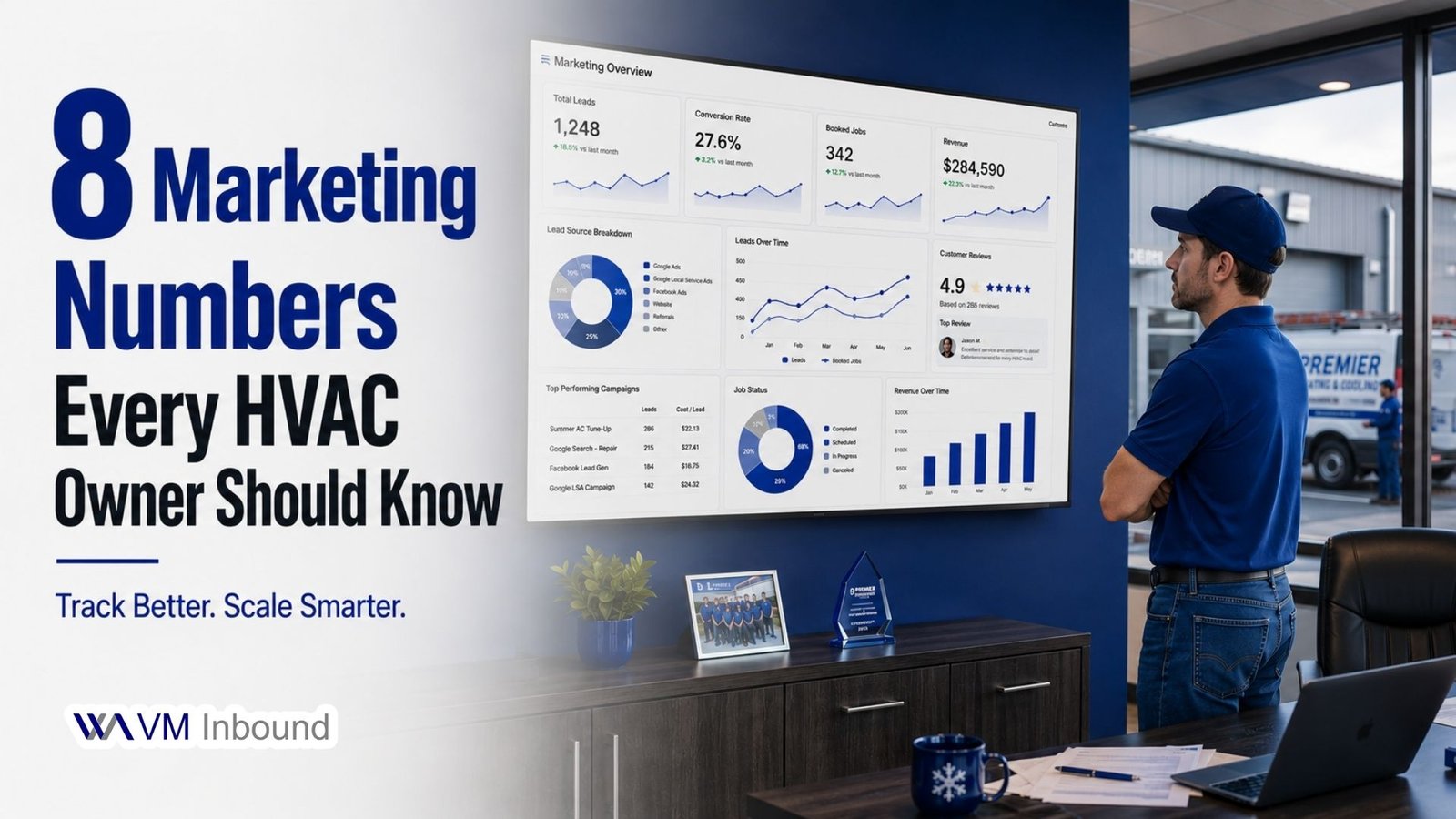
If you are running your HVAC business based on “what feels like it’s working,” you are likely overspending, under-scaling, or both. The difference between stagnant companies and those that grow consistently is not luck; it is visibility into the right HVAC marketing metrics.
Owners who scale know exactly where their leads come from, how much they cost, and how often they turn into revenue. When you track the right numbers, your marketing stops being a gamble and starts becoming a predictable growth system.
You’re Tracking the Right HVAC Numbers. Now Plug Them Into a Done‑for‑You Booking System.
Lead Generation Metrics to Track
Before you can improve your revenue, you need to understand how leads are entering your pipeline.
Leads by Channel
Not all leads are created equal. Track how many leads come from each source:
- Google Ads
- Organic search (SEO)
- Facebook or social media
- Referral and word-of-mouth
- Direct website visits
This tells you where your visibility is strongest and where to invest more. For example, if Google Ads brings in 60% of your leads but at a high cost, while SEO brings in 25% at a lower cost, that insight helps rebalance your budget.
Cost Per Lead (CPL)
Cost per lead is one of the most important HVAC marketing metrics.
Formula:
Cost per Lead = Total Marketing Spend ÷ Number of Leads
If you spend $2,000 on ads and generate 100 leads, your CPL is $20. This number helps you evaluate efficiency. A lower CPL does not always mean better; it must be paired with conversion quality, but it is your first indicator of performance.
Conversion Metrics to Track
Getting leads is only half the battle. What matters is how many of those leads turn into paying jobs.
Lead-to-Booked Job Rate
This measures how many inquiries actually get scheduled.
Formula:
Lead-to-Booked Rate = Booked Jobs ÷ Total Leads
If you receive 100 leads and book 60 jobs, your rate is 60%. A low number here often points to issues in response time, call handling, or follow-up systems.
Close Rate
This tracks how many booked jobs turn into completed, paid services.
Formula:
Close Rate = Completed Jobs ÷ Booked Jobs
If your team books 60 jobs but only closes 45, your close rate is 75%. This can highlight issues in pricing, technician performance, or customer trust.
Average Ticket by Service Type
Not all services bring the same revenue. Break down your average ticket by:
- Repairs
- Installations
- Maintenance services
This allows you to identify which services are most profitable and worth promoting more heavily. For example, if installations bring in significantly higher revenue per job, your marketing strategy should reflect that.
Customer Value Metrics to Track
Growth does not just come from new customers, it comes from maximizing the value of each customer over time.
Repeat Business Rate
This shows how often customers come back for additional services.
Formula:
Repeat Customer Rate = Returning Customers ÷ Total Customers
HVAC businesses with strong maintenance plans and follow-up systems often outperform competitors because they generate predictable recurring revenue.
Review Volume and Rating
Your online reputation directly impacts conversion rates. Track:
- Total number of reviews
- Average rating
- Frequency of new reviews
A steady flow of positive reviews improves local SEO rankings and builds trust before customers even contact you.
Referral Rate
Referrals are high-quality, low-cost leads.
Formula:
Referral Rate = Referral Leads ÷ Total Leads
If referrals make up a small percentage of your leads, it may be time to implement incentives or simply ask satisfied customers more consistently.
Simple Dashboard Recommendations
You do not need complex software to track these HVAC marketing metrics. A simple dashboard can give you clarity:
- Use Google Sheets or a CRM to log weekly data
- Track metrics per channel and per campaign
- Review numbers every week, not monthly
- Focus on trends, not just snapshots
A basic dashboard might include:
- Total leads by source
- Cost per lead by source
- Booking rate
- Close rate
- Revenue per job
- Total revenue per channel
When you see these numbers in one place, decisions become easier. You will know what to scale, what to fix, and what to stop.
Turn Data Into Growth
Tracking numbers is not about adding more work; it is about removing guesswork. HVAC owners who understand their metrics can confidently invest in the channels that drive real results and eliminate wasted spend.
If you want consistent leads, better conversion rates, and predictable revenue, the next step is having a system that captures, tracks, and converts those leads effectively.
Explore how a high-performing HVAC repair landing page can help you generate and convert more qualified leads.
Seeing Leads but Not Enough Booked Calls?
Get a Local Strategy Built Around Your Numbers.